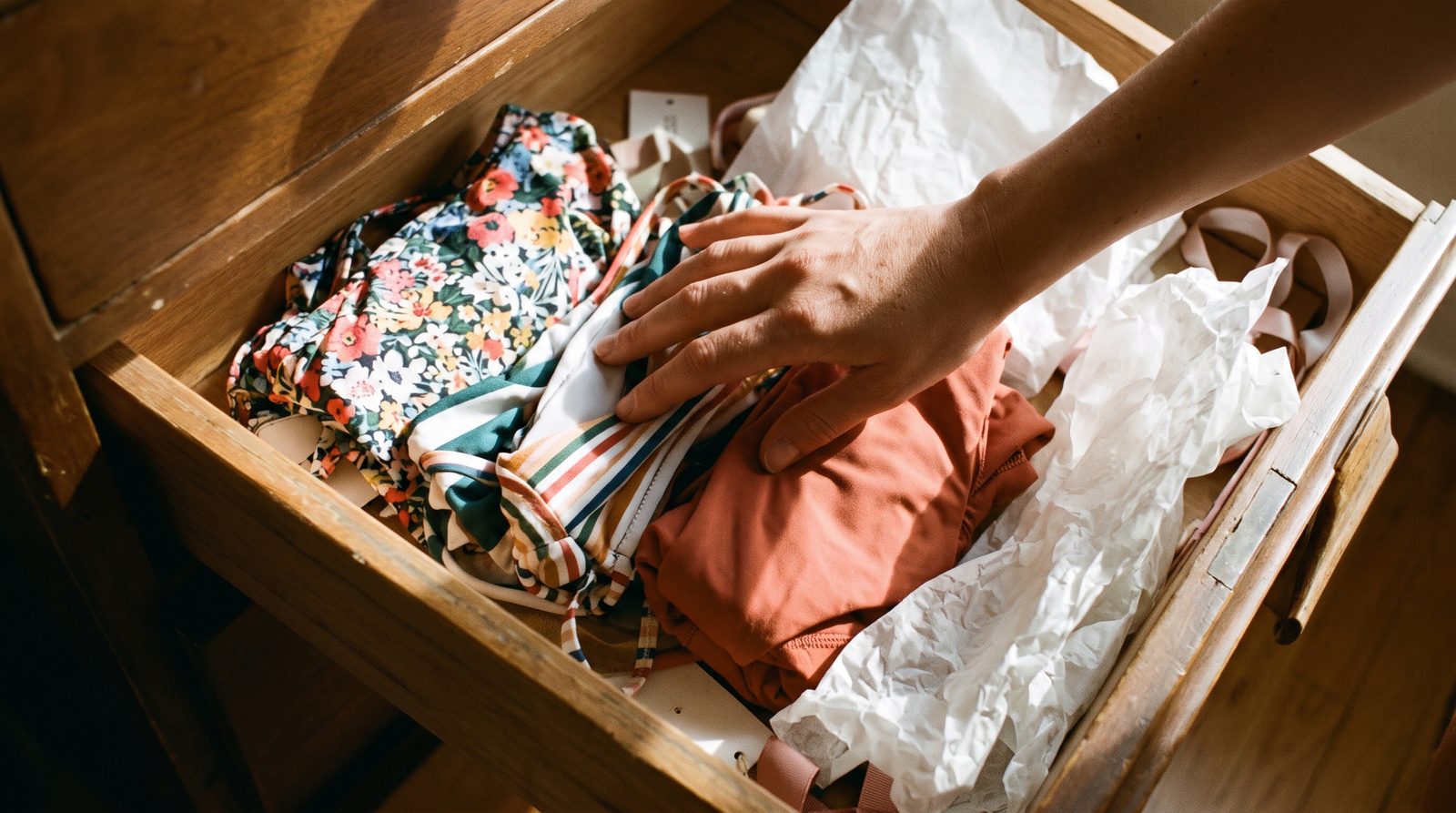
How to store swimwear is the part of care nobody photographs, and it is where most suits quietly lose their shape. A swimsuit put away damp smells of mildew within 48 hours; one hung wet from a single strap stretches 2–3 cm at the shoulder; one sealed in a plastic bag in a warm drawer keeps a crease across the seat all winter.
The fix is unglamorous: dry it completely, fold it loosely, keep it away from heat and plastic, and rotate between two suits. Five minutes of setup protects the elastane that does all the work.
Dry it completely before it goes anywhere
A swimsuit can feel dry to the touch and still hold 15–20 g of water in the lining, the elastic at the leg and the strap channels. That is enough moisture to grow mildew in a closed drawer at 24°C. Give it 12 hours on a flat rack in moving air, not two hours on a towel.
The lining dries last. Turn the suit inside out for the final hour and check the gusset and underband with the back of your hand — if it feels cool, it is still damp. In a humid bathroom with no window, that can take six hours longer than you expect. Never finish the job on a radiator or with a hairdryer: elastane begins to lose recovery above 40°C, and the damage shows up months later as a shiny seat no wash will fix.
- Roll in a towel for two minutes to pull out most of the water
- Lay flat, shaped by hand, in shade with moving air
- Turn inside out for the last hour
- Check the gusset and underband with the back of your hand
- No radiator, no tumble dryer, no hairdryer
Fold loose, roll, or hang — but never by one strap
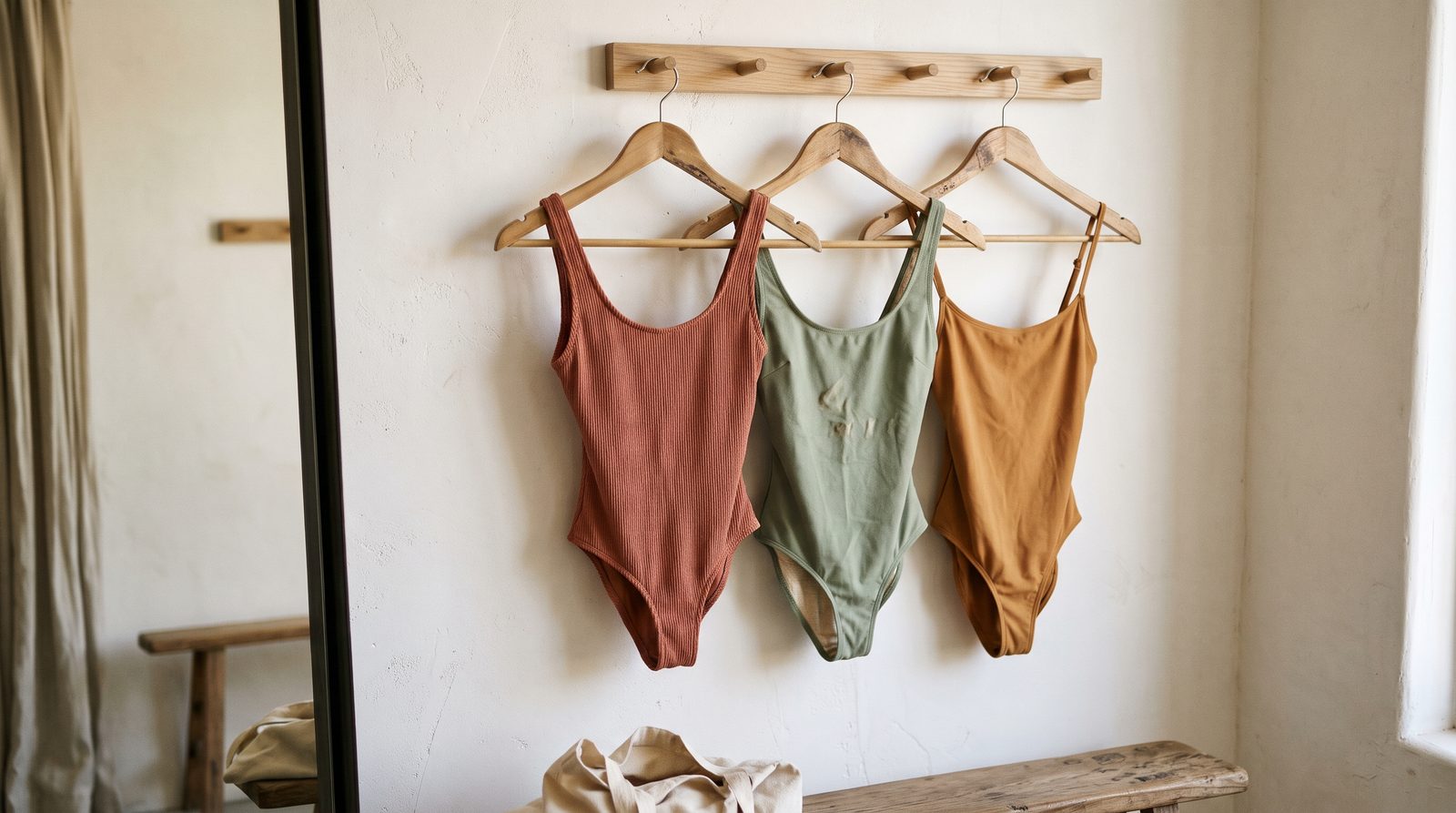
A wet swimsuit weighs about 500 g, and hanging that from one shoulder strap for an afternoon is enough to stretch it permanently. Even a dry suit on a wire hanger develops pointed shoulders and a stretched neckline after a season. If you must hang, use a padded hanger and take the weight across the whole back, not the straps.
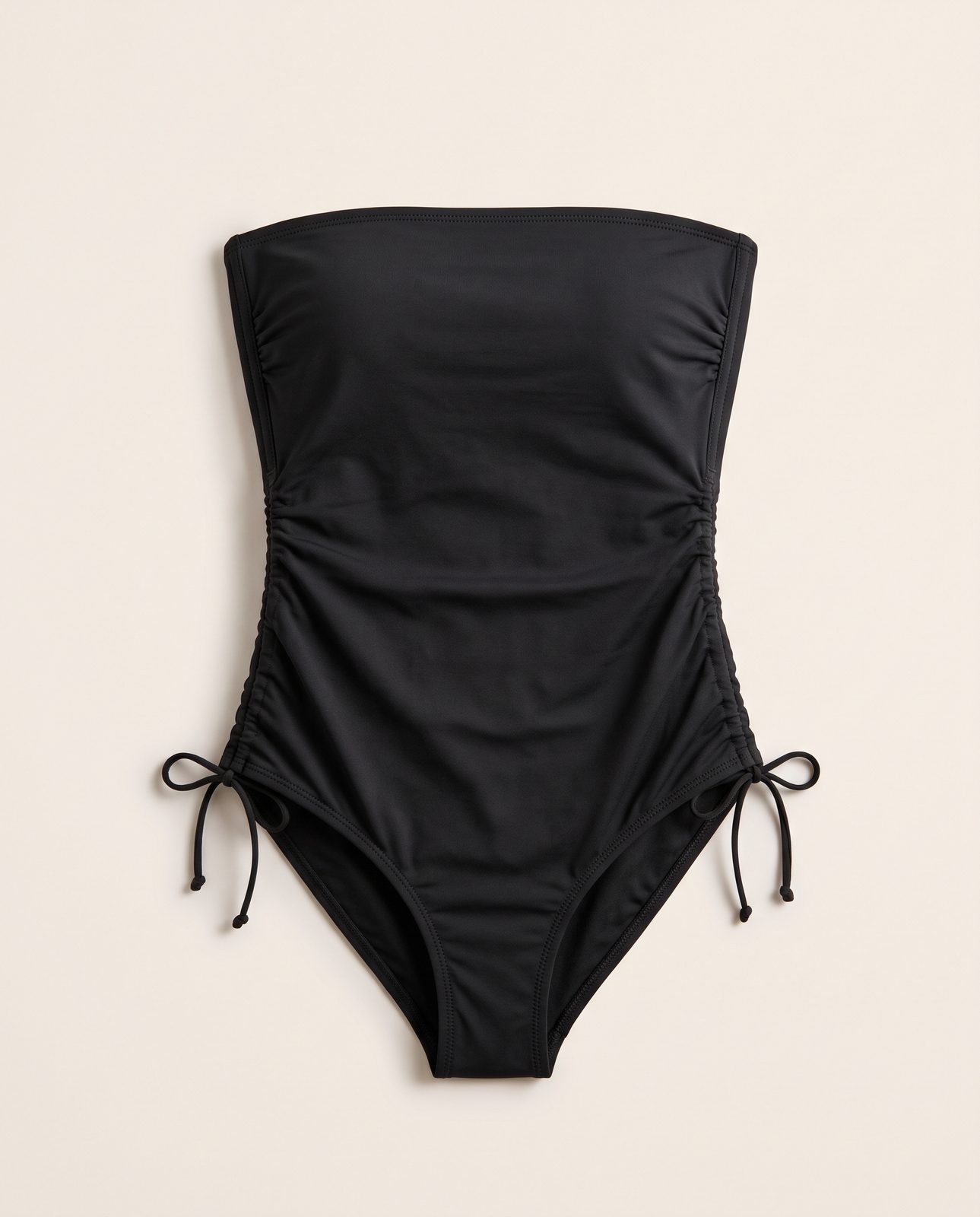
For drawers and shelves, fold the suit in half lengthways, tuck the straps inside and roll it loosely from the bottom. Rolling avoids the hard crease that folding leaves across the seat, and it lets you see every suit at a glance. Stack no more than four deep so nothing presses a fold into the elastane for months. Roll anything ruched rather than folding it — our ruched bandeau one-piece (€95) presses into a permanent pleat under weight.
No plastic, no heat, no direct sun
Plastic bags trap moisture and heat, the worst combination for elastane. A suit stored in a sealed bag in a hot car boot can sit at 50–60°C for hours. Use a cotton drawstring bag, a mesh pouch or simply a drawer with air around it.
Keep the storage spot below 25°C and out of direct sun. A shelf in a south-facing wardrobe will fade coral and Riviera blue noticeably over one summer even though the suit is never worn, because UV still reaches it through glass. If your flat runs humid — coastal flats often sit above 65% relative humidity — add a silica gel sachet to the drawer, but keep it out of the bag where it can leave a chalky mark.
Rotate two suits, ideally three
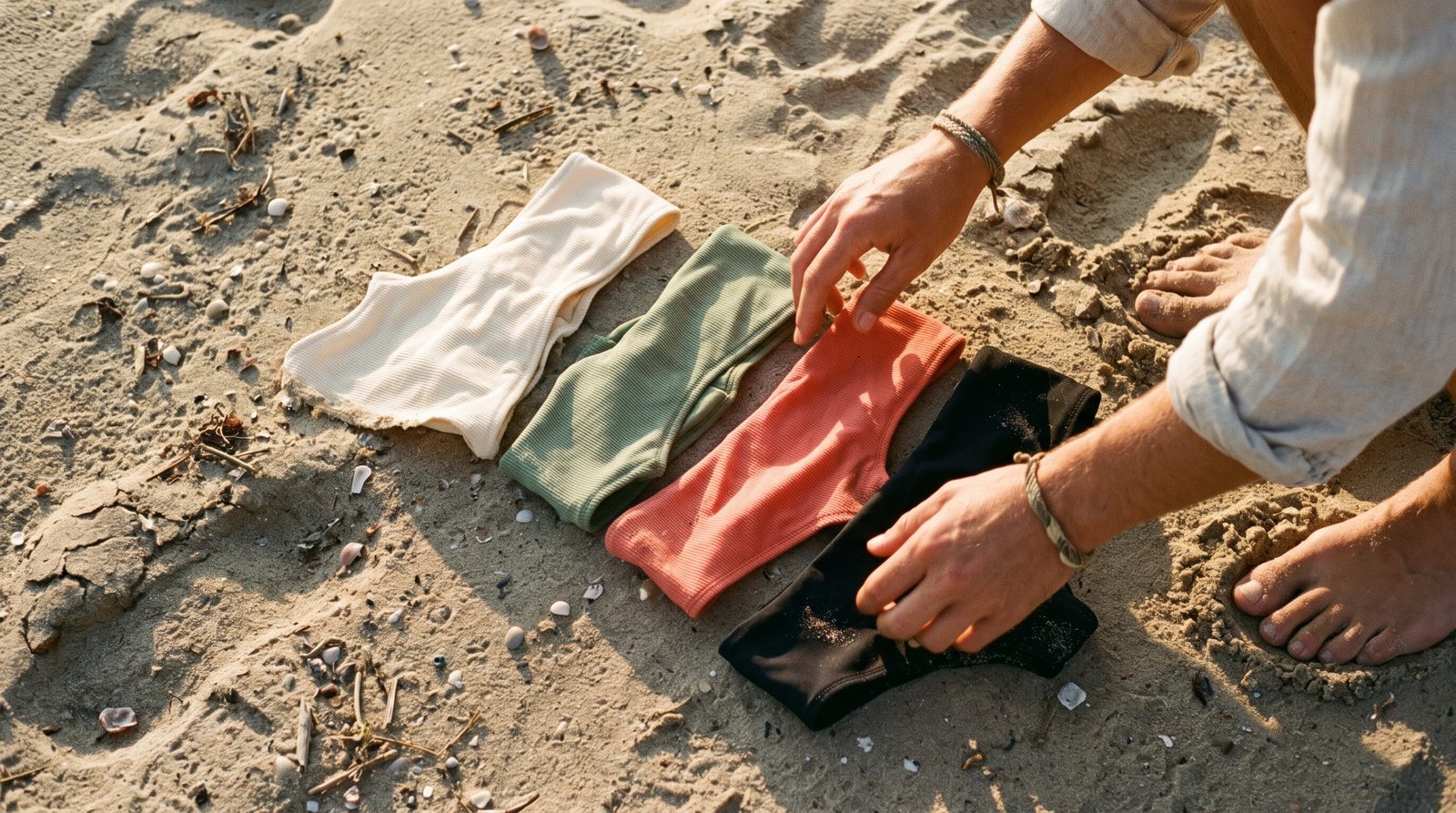
Elastane needs roughly 24 hours to recover its shape after a day of wear. A single suit worn every day never gets that window, which is why daily swimmers see sag at the seat and straps long before occasional swimmers do. Two suits worn alternately will each last nearly twice as long as one worn hard.
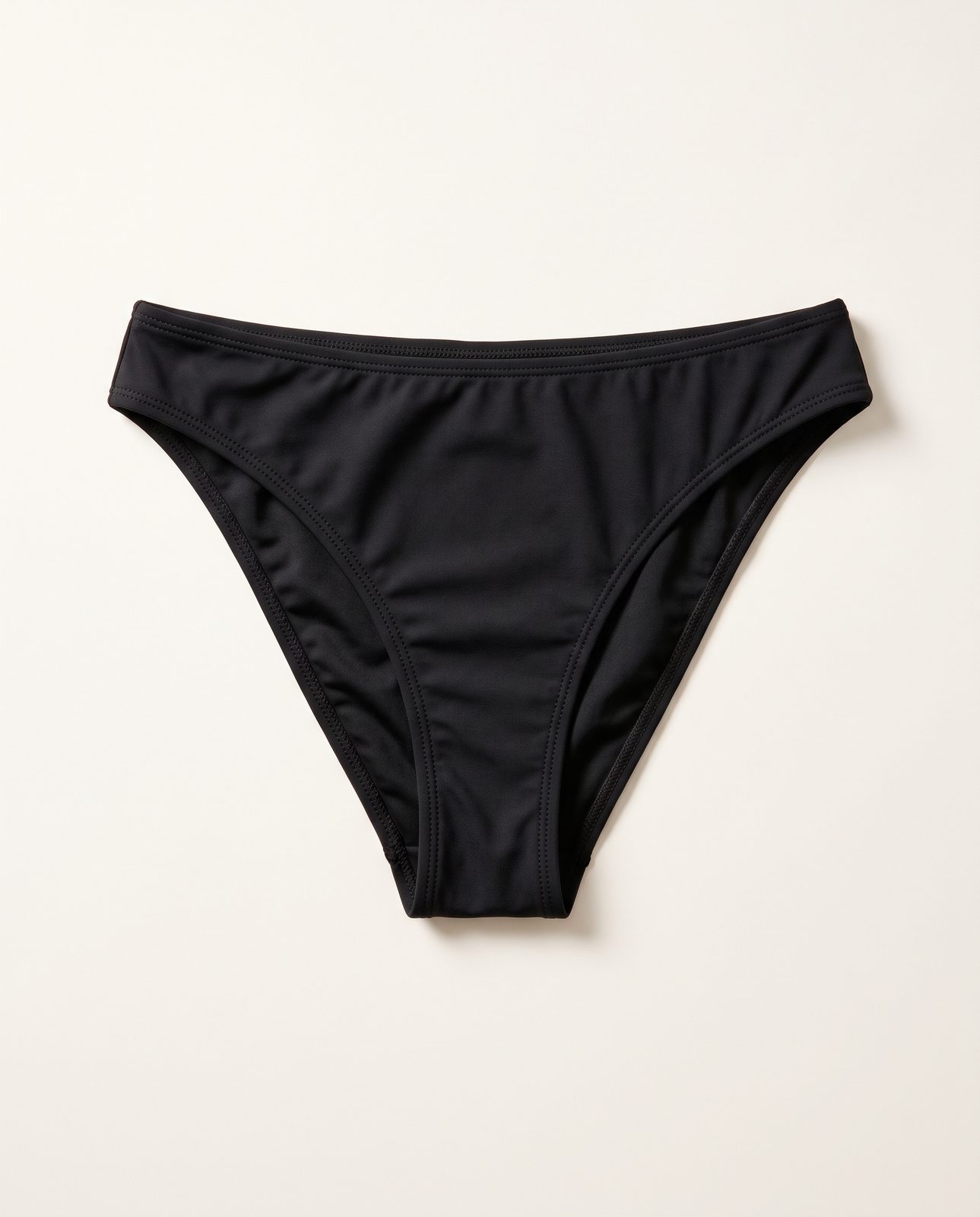
Rotation also spreads the UV and chlorine exposure. If you swim five times a week, a three-suit rotation at 78–82% polyamide, 18–22% elastane will comfortably give you 18 months before the first suit softens, against 8–10 months for a single suit in the same routine. Our high-leg bikini bottoms dry in under an hour, which makes a quick rotation realistic in a small flat.
Travel storage: the mesh pouch method
On the road, pack swimwear in a mesh pouch rather than a plastic bag, and pack it dry. A damp suit in a suitcase for a six-hour flight will smell before you reach the hotel. If you have to travel with it wet, use a dedicated wet bag and unpack it the moment you arrive.
In a hotel room, the best drying spot is usually not the bathroom. Look for a balcony in shade, a window with a breeze, or the space above the air-conditioning vent. A 220 g/m² knit dries in 30–45 minutes in moving air and six hours in a steamy bathroom. Shake sand out before packing, because grains trapped in the lining abrade the fibres every time the bag moves.
Seasonal storage: the four-step reset
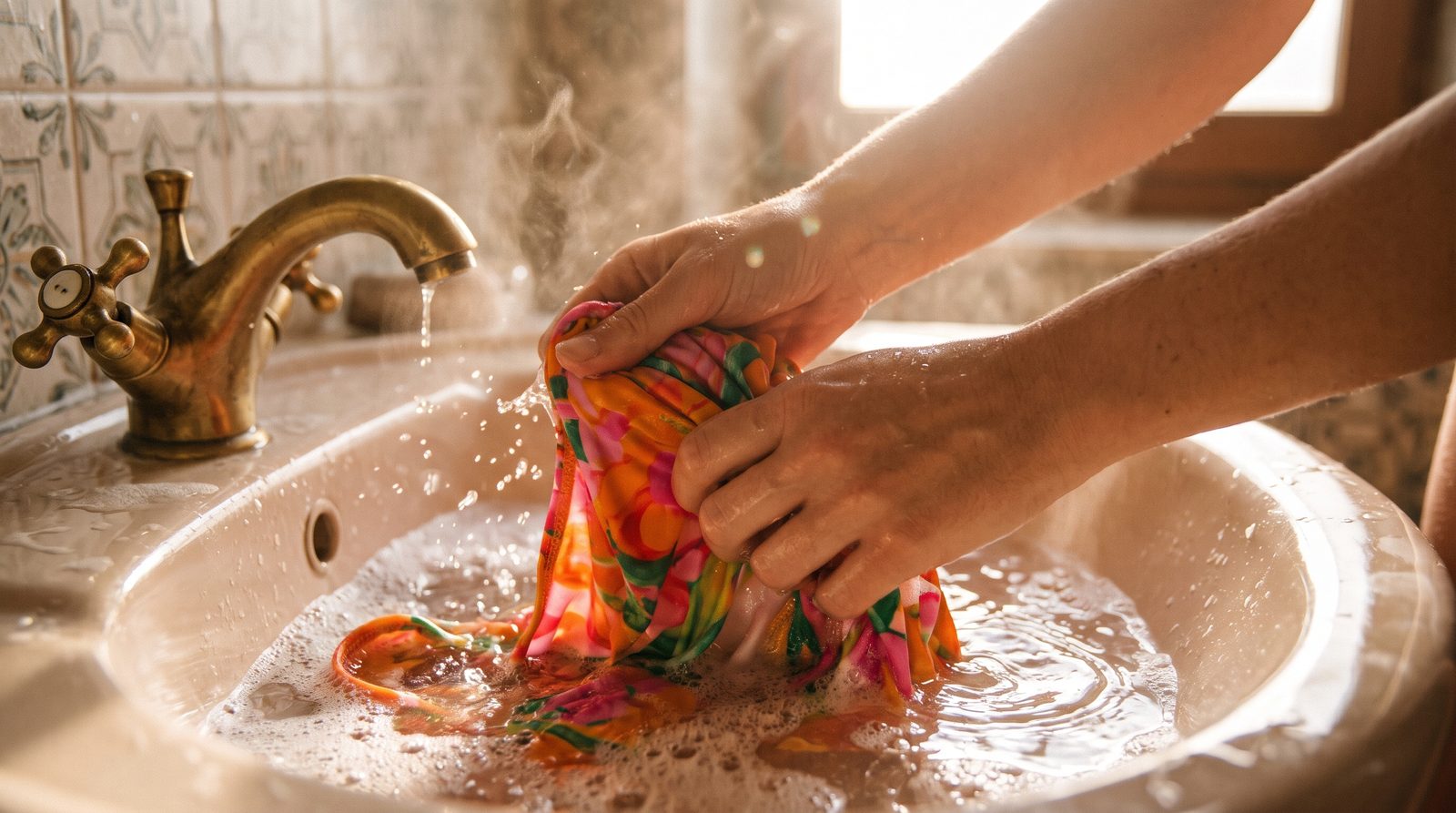
At the end of the season, wash every suit by hand with 5 ml of mild detergent, rinse twice, roll in a towel and dry flat. Do not store anything worn and unwashed — body oils oxidise over the winter and turn the underband yellow.
Then fold or roll loosely into a cotton bag, leave the bag open, and put it on a shelf rather than under the bed where it will be compressed. Vacuum sealing crushes cups and puts permanent creases in the knit. Check the bag once mid-winter: if it smells musty, wash and dry the suit again; if a strap has taken a set, a five-minute soak in cool water and a flat dry will relax it.
- Wash and dry completely before storing
- Cotton bag, left open, on a shelf
- No vacuum sealing and nothing heavy on top
- Check once mid-winter and re-dry if needed
- Keep below 25°C and out of direct sun
Frequently asked questions
Can you hang a swimsuit to dry?
Not by the straps. A wet suit weighs around 500 g and will stretch a single strap within an afternoon. Dry it flat, or hang it over a padded hanger with the weight spread across the back.
Can I store swimwear in a plastic bag?
Avoid it. Plastic traps moisture and heat, which is exactly what elastane cannot tolerate. Use a cotton or mesh bag, or a drawer with air around the suit.
Why does my swimsuit smell musty after storage?
It went away with moisture still in the lining, usually 15–20 g of it. Wash it in cool water with mild detergent, dry it flat for a full 12 hours and store it somewhere with air movement.
How long can you store a swimsuit without wearing it?
Several seasons, if it is clean, bone dry and kept below 25°C out of sunlight. Check it once a year and re-dry it if the drawer feels humid.
Should swimwear be folded or rolled?
Rolled is better for anything with ruching, cups or a firm rib. Folding is fine for simple knits as long as the stack is no more than four deep and nothing heavy sits on top.