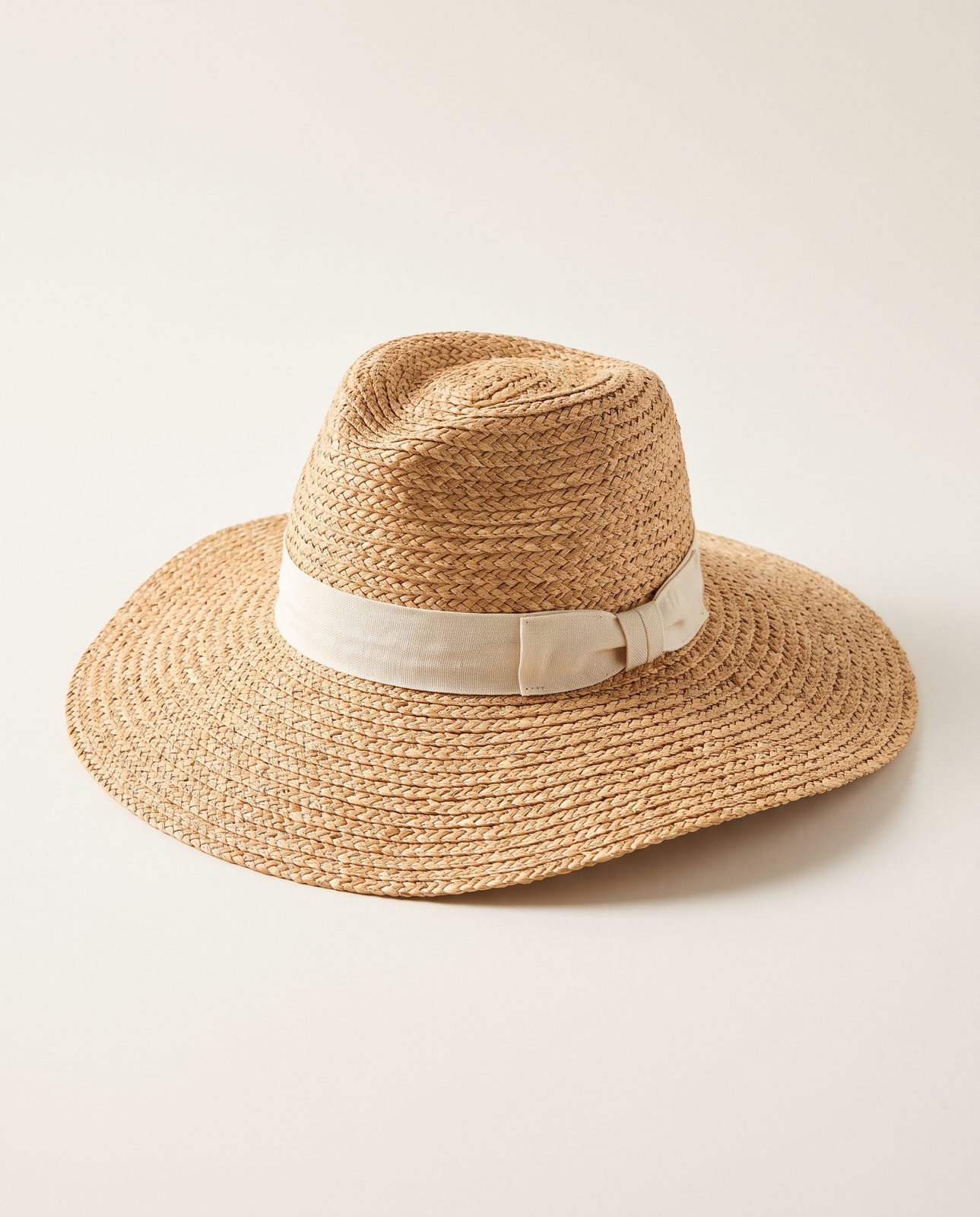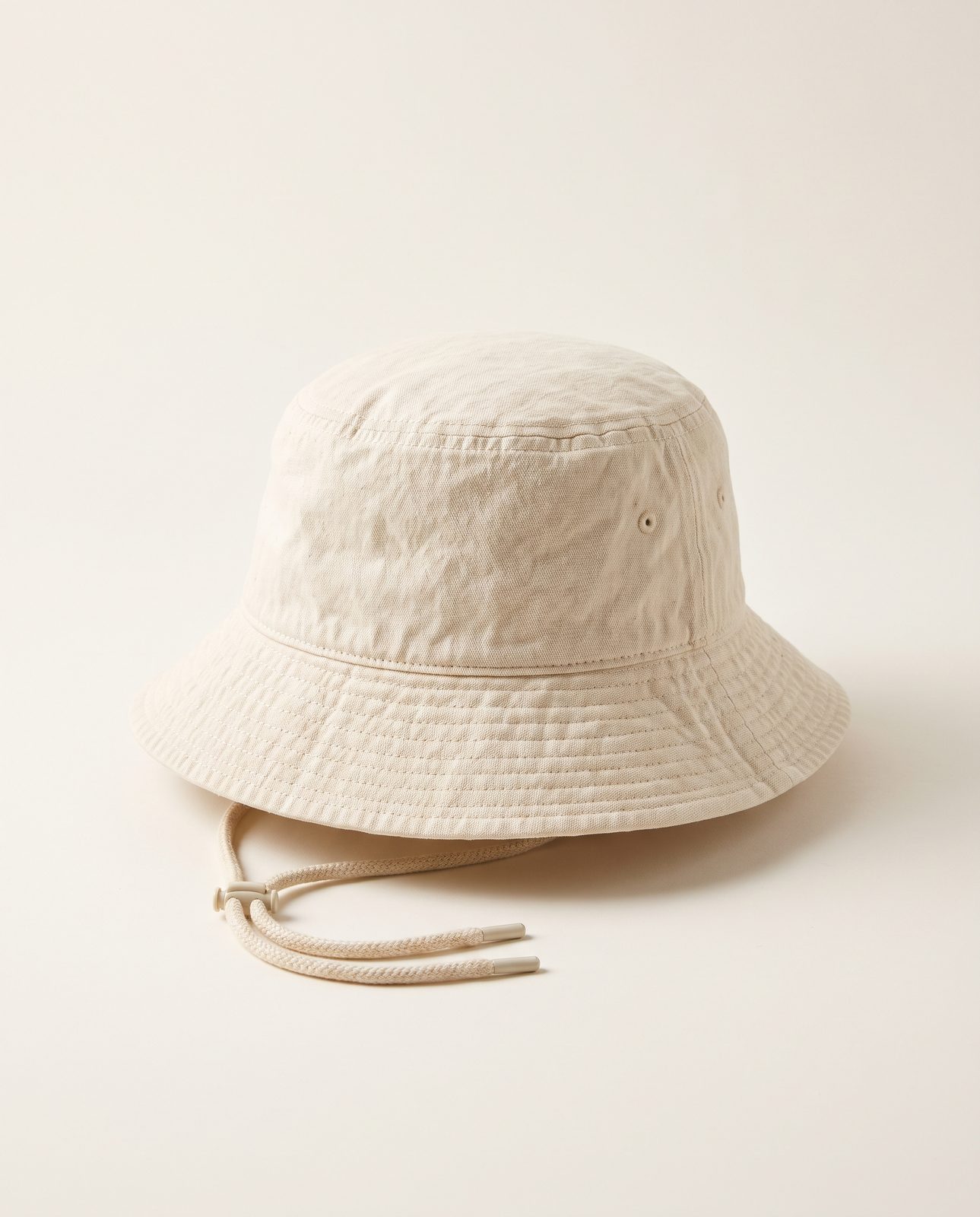
The best beach hat is the one you still have at the end of the holiday. That means three things working together: a brim wide enough to shade your face, a weave tight enough to do something, and a fit that survives a gust on an open beach. Most hats people abandon fail on the third point, not the first.
Here is how we would choose one, in the order that matters: measure, then brim, then weave, then fit details. It takes about four minutes and saves buying two hats you never wear.
Measure your head before you look at a single hat
Run a soft tape around your head about 1 cm above the ears, across the forehead and around the widest part at the back. Keep it level and snug, not tight. Most adult women measure 54–58 cm and most men 56–60 cm, which is why hats come in S/M and L/XL rather than a single size.
If you land between sizes, take the larger one and use the inner drawstring or a strip of foam tape under the sweatband. A hat 1 cm too small leaves a red line across your forehead after an hour and will be the first thing you take off. Ponytails and thick hair add around 1 cm, so measure with your hair the way you will wear it on the beach.
- Tape 1 cm above the ears, level around the head
- Under 55 cm: look for adjustable or children's sizing
- 55–58 cm: most S/M hats
- 59 cm and above: L/XL, or a men's cut with a deeper crown
- Between sizes: size up and pad the sweatband
Brim width: 8 cm, 10 cm or 12 cm
Brim width is the single number that decides how much shade you get. At 6–7 cm the hat shades the forehead and the top of the nose but leaves the cheeks and jaw in direct light. At 8–9 cm you cover the face down to the chin when the sun is high. At 10–12 cm the neck and tops of the shoulders come into shade too, which is what you want for a long lunch outdoors.
Wider is not automatically better. Past 12 cm the brim starts to block peripheral vision, catches wind like a sail and makes a straw hat heavy enough to press on your forehead. For a boat, a market or a windy beach walk, 8 cm with a chin cord is more useful than 14 cm without one. A slight downward curve at the front gives more real shade than a flat brim of the same width.
Weave density: hold it up to the light
Take the hat to a window and look through the crown. If you can see a scatter of bright pinpricks, the weave is open and the hat is mostly decoration. If the light comes through as a soft even glow, the straw is tightly woven and will cut a meaningful amount of direct sun.
Material matters for weight and breathability more than for style. Paper straw is light at around 120 g and holds a shape well but dislikes rain. Raffia is springier, slightly heavier and survives being folded into a bag. Cotton canvas at 260–300 g/m² is the most hard-wearing and easiest to wash, though warmer at 35°C. No hat replaces sunscreen on the ears, nose, neck and feet: treat it as shade for the face and scalp.
Fit details that decide whether you keep wearing it
A cotton sweatband is the difference between a hat you wear for six hours and one you wear for forty minutes. It absorbs about 10 ml of sweat before it feels damp, and it stops the straw marking your forehead. Look for one that is stitched, not glued, so it can be replaced.
Check the crown height against your sunglasses. A crown of 10–11 cm clears most frames; a shallow 8 cm crown pushes the arms down onto your ears. A chin cord is not just for boats either — any 10 cm brim lifts in a 25 km/h gust, and a cord with a small toggle costs nothing and saves the hat.
Packing a beach hat without crushing it
A soft raffia or cotton hat can be rolled into a cone and packed inside a shoe or wrapped around a towel. A blocked straw hat cannot: pack it crown-down in the centre of the case with soft items around the brim, and put nothing heavy on top.
If the brim does arrive bent, steam it for 30 seconds over a kettle, bend it back gently with both hands and let it dry crown-up on a flat surface for two hours. Never use a hairdryer on straw — the heat makes it brittle. For a week-long trip, wearing the hat on the plane is often the simplest answer.
Cleaning sweat, salt and sunscreen out of a straw hat
Sunscreen and sweat leave a visible tide line on the sweatband within a few wears. Wipe the band with a cloth wrung out in cool water and a drop of mild detergent, blot it dry and let the hat air dry crown-down so the brim does not sag. Salt spray is easier: a quick wipe with a damp cloth after a boat day is enough.
Do not soak a straw hat, and never leave it wet in a beach bag — paper straw softens and loses its block within an afternoon. Store it crown-down or hanging by the crown, never by the brim: a 150 g hat hung by the edge for a winter is enough to pull the brim permanently out of shape.
- Wipe the sweatband after every second wear
- Air dry crown-down, never on a radiator
- Spot-clean only; do not soak straw
- Store by the crown, not the brim
- Keep it out of a hot car boot, where 60°C will warp it
Frequently asked questions
What brim width is best for a beach hat?
8–10 cm shades the face properly and still lets you see where you are walking. Go to 10–12 cm for long lunches and sunbathing, and back to 8 cm for windy beaches or boats.
Can you pack a straw beach hat in a suitcase?
Soft raffia and cotton hats can be rolled and packed. Blocked straw hats need to travel crown-down with soft clothes packed around the brim, or be worn on the journey.
How do I stop a beach hat blowing off?
Use a chin cord with a toggle, and size the hat so it sits just above the ears rather than resting on top of your head. A slightly deeper crown catches less wind than a shallow one.
Is a tight weave better than a wide brim?
Both matter, but a tight weave is the one people underestimate. Hold the hat to the light: if you see clear pinpricks, the shade it gives is mostly symbolic.
How do I clean sunscreen off a straw hat?
Dab the marked area with a cloth dampened in cool water and a drop of mild detergent, then blot and air dry crown-down. Never submerge a straw hat or dry it near a radiator.