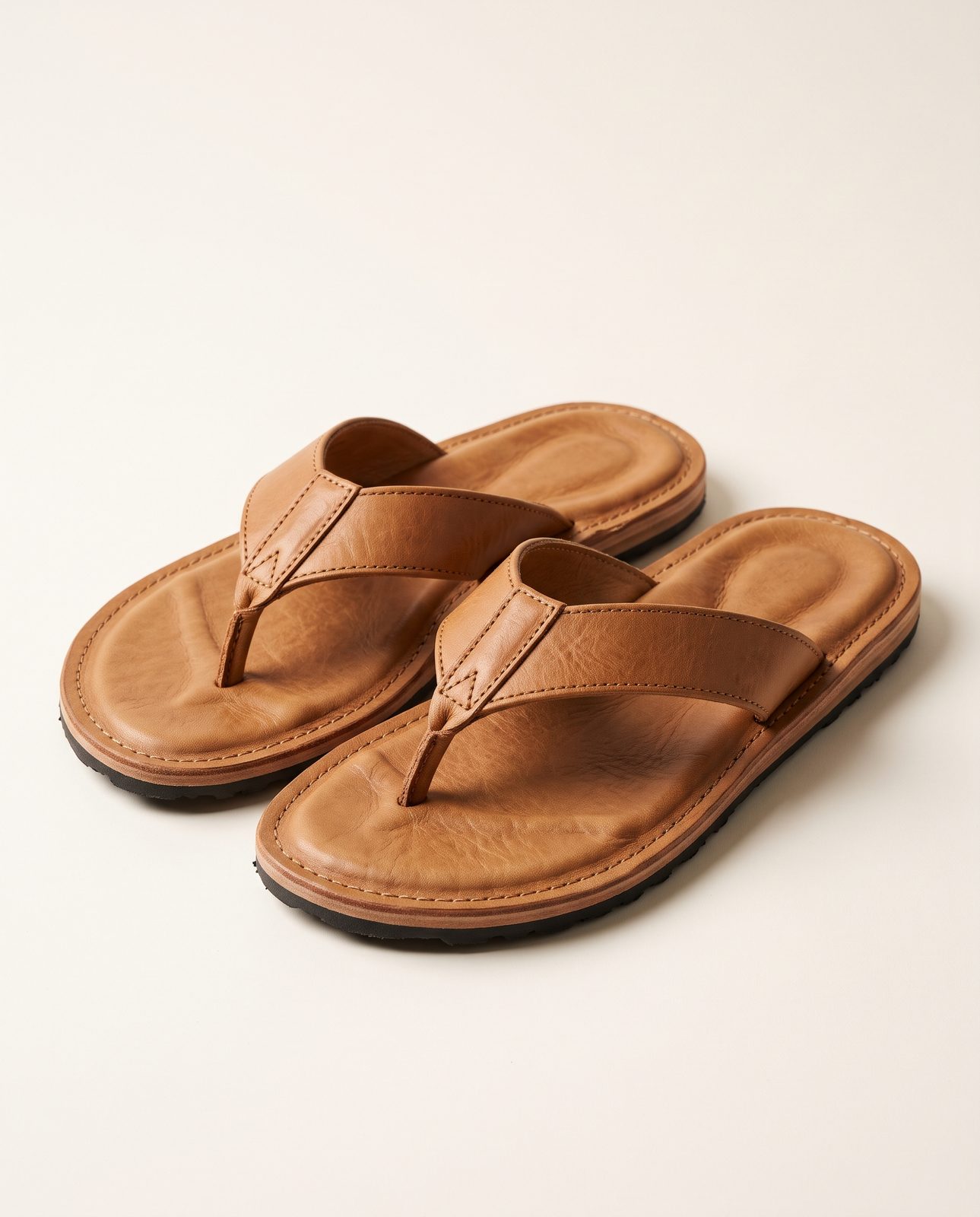
Most bad flip-flops are not badly made; they are badly sized. A pair that is 1 cm too long makes you curl your toes to keep it on, and a toe post that sits too far forward rubs the web of the foot raw within 20 minutes. This flip-flops buying guide covers the four measurements worth checking before you pay, from heel gap to tread depth.
We have sold leather and rubber pairs on the Spanish coast for years, where pavements hit 40 °C in August and beach tiles stay wet all day. These are the checks we run on every sample, plus how to break a new pair in without blisters.
Fit: the 5 mm rule at the heel
Stand on the sandal with your heel in place. There should be 3–5 mm of sole behind your heel and 5 mm in front of your longest toe. More than 10 mm at the back and the sole catches on steps; less than 2 mm and your heel overhangs, which is how most flip-flop sprains start.
Width is the second check. Your foot should sit inside the sole with about 5 mm visible on each side. If the little toe hangs over the edge, go up a size even if the length looks right. Leather straps relax by roughly half a size in the first fortnight, so a pair that feels tight across the instep on day one is usually correct. Try them on late in the day, when feet have swollen by up to 5 mm after walking.
Sole thickness: what 10 mm, 15 mm and 25 mm do
Under 8 mm of sole you feel every stone on a shingle beach and most of the pavement on the way there. A 10–12 mm rubber sole is the sensible minimum for town and cobbles, and it still rolls up small enough for a case. Our leather flip-flops sit at 12 mm, which is the thinnest we would wear for a 2 km walk.
A 20–25 mm platform looks generous but raises your centre of gravity on uneven sand and rolls the ankle sideways. Keep platforms for poolside and boat decks. Also check what the sole is made of: EVA foam at 80 kg compresses by 20–30% over one summer, so a €20 pair often feels flat by September. If a thumbnail pressed into the sole leaves a mark that stays, the foam is too soft for daily walking.
Wet grip is a texture question
Smooth rubber on wet pool tile is a skating rink, whatever the marketing says. Turn the sandal over and look for a tread with 2–3 mm deep grooves and a pattern that pushes water sideways rather than trapping it under a flat sole. A herringbone or zigzag tread works; a shallow logo stamp does not.
The footbed matters just as much. Bare leather becomes slick when wet, so leather uppers should sit on a rubber outsole with a textured footbed. If you will wear them in the shower or on a boat, choose a moulded rubber footbed with raised dots — it grips a wet foot far better than flat leather. On a wet pool deck, take short steps for the first few paces until the tread has shed the surface film.
Leather or rubber: weight, moulding and salt
A leather pair weighs around 280 g; a rubber pair about 180 g. That 100 g is the difference between a sandal that disappears on your foot and one you notice on a long walk. Leather also moulds to your foot in about two weeks and looks better with age, which is why we keep leather flip-flops at €59 rather than chasing the cheapest option.
The cost is maintenance. Salt water dries leather stiff and leaves a pale tide line, so rinse in fresh water, dry in shade and never on a hot car dashboard. Rubber needs nothing but a rinse, though it can crack where the toe post meets the sole after two or three seasons of sun. Store leather pairs flat rather than hooked by a strap, which stretches the toe post over a few months.
Flip-flops buying guide: the five-minute check
Try both feet, not just one — most people are half a size different left to right. Walk 20 paces on a hard floor: if the heel audibly slaps, the sole is too long or too stiff. Twist the sandal gently; it should flex at the ball of the foot, not fold in half at the arch.
Finally, check the toe post anchor. It should be set about a third of the way back from the front edge, with a wide base plate under the sole. A post that pulls through is the single most common failure we see, and it is visible in the shop before you buy.
- 3–5 mm of sole behind the heel, 5 mm in front of the toe
- 5 mm of sole visible on each side of the foot
- 10–12 mm sole for pavements and cobbles
- 2–3 mm tread depth for wet tiles
- Toe post anchored one third back from the front edge
- Flex at the ball of the foot, not at the arch
Frequently asked questions
Should flip-flops be tight or loose?
Snug across the instep, with room to slide one finger under the strap and no more. Too loose and your toes grip to keep the sandal on, which causes cramp and blisters. Leather will give about half a size, so start snug rather than roomy.
How long does it take to break in leather flip-flops?
Around two weeks of regular wear, or three sessions of 20 minutes if you are impatient. Dampen the straps very slightly before the first wear and stay off long walks until the leather has softened.
Can I wear flip-flops for a whole day of sightseeing?
Not comfortably on cobbles. A 12 mm sole helps, but flip-flops offer no ankle support and no heel cushioning for 15,000 steps. We wear them to the beach and change into trainers for the old town.
How do I remove salt stains from leather flip-flops?
Wipe with a cloth dampened in equal parts white vinegar and water, then buff dry and apply a light leather balm. Rinse the soles separately with fresh water and dry everything in shade.