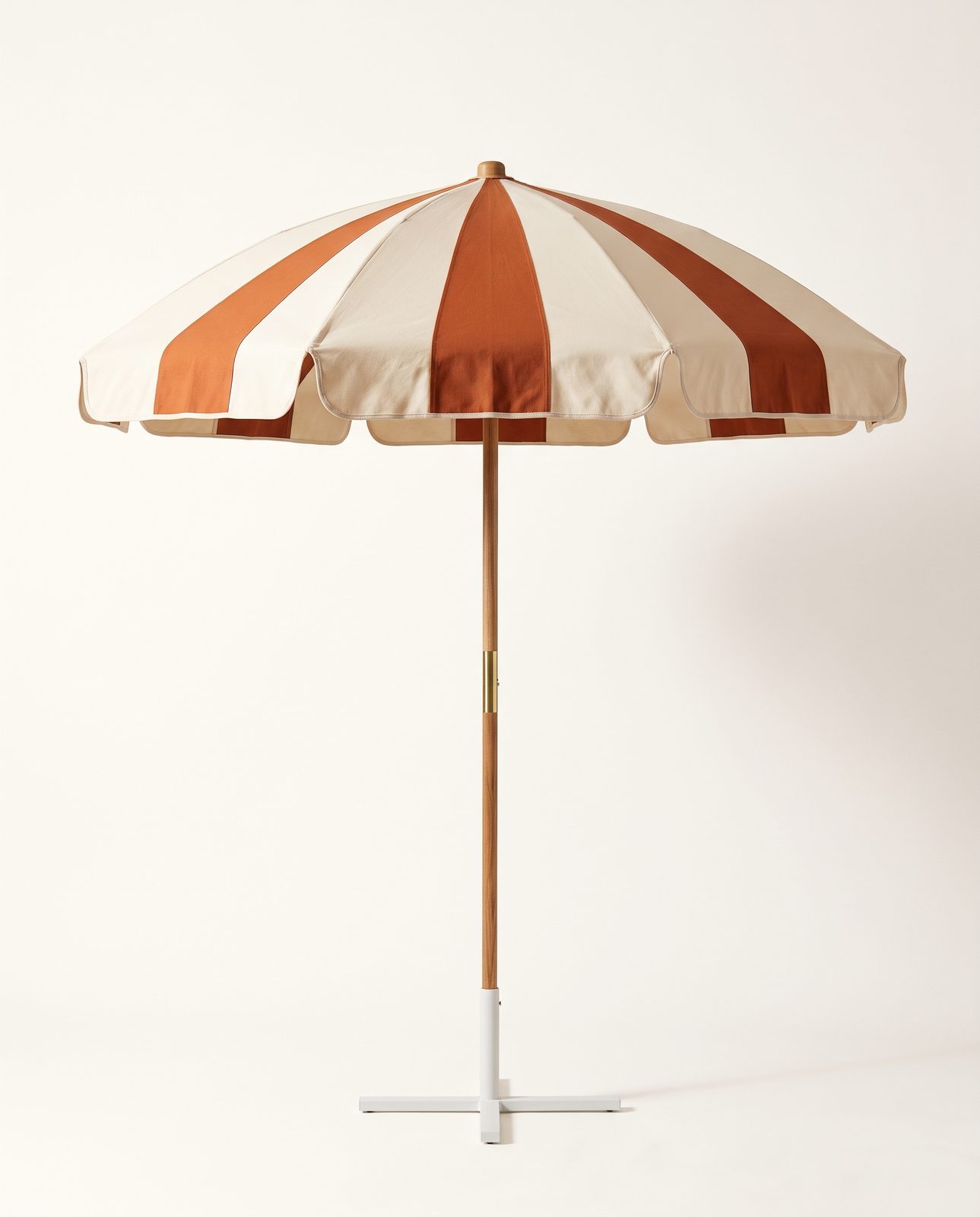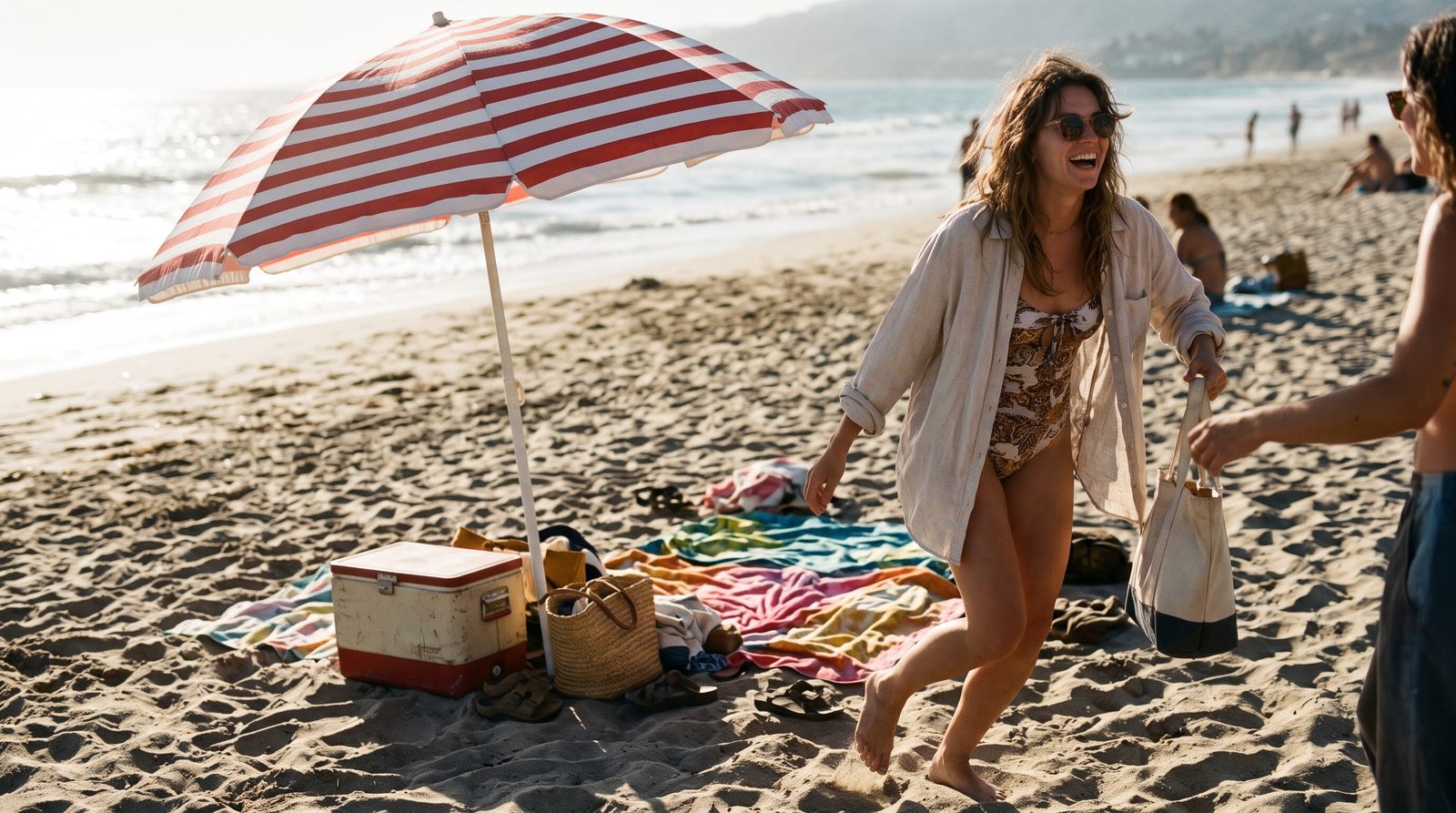
A beach umbrella fails for one of two reasons: the canopy is too small to shade two people, or the anchor is too shallow for the wind. Buy on canopy diameter and wind behaviour, not colour — 200 cm of canopy and a 35 cm sand screw will do more for a day at the beach than any print.
We sell one umbrella and spend a lot of time watching other people's, so we have seen how they fail. These are the four specifications that decide whether yours stays up, plus what to pay in 2026.
Beach umbrella guide: the four numbers that matter
Canopy diameter: 180 cm shades one person and a bag; 200–220 cm shades two chairs; 240 cm and above is a family umbrella that needs two people to put up. Measure the diagonal if the listing quotes a radius — an “110 cm umbrella” is usually 220 cm across.
Pole diameter and material: 32 mm aluminium is the standard for a portable umbrella, while 38 mm is sturdier and adds 600–800 g. Packed length: 120–140 cm fits a car boot, 90–110 cm fits a suitcase. Weight: 1.8–2.5 kg is carryable for ten minutes; 3.5 kg is a two-person job with a bag.
- 180 cm canopy: one person, about 2.0 kg, €35–55.
- 200–220 cm canopy: two people, 2.4–3.0 kg, €55–90.
- 240 cm and above: family, 3.5 kg or more, €90–140.
- Check the ribs: fibreglass flexes back, steel bends and stays bent.
Wind is the specification nobody prints
Most umbrellas are rated informally, often not at all. What you can check is construction: a vented canopy with a mesh panel at the top lets gust pressure escape instead of lifting the pole, six fibreglass ribs survive a gust that snaps eight steel ones, and a tilt joint that locks at 30° and 45° lets you follow the sun without moving the anchor.
Take it down at around 25 km/h of wind, which on an open beach is the point where sand starts to move. Never leave an umbrella up unattended, and do not let children shelter under one in wind — the pole is the part that falls.
Canopy fabric: gsm, coating and shade
Cheap canopies are 170–190T polyester, roughly 90–110 gsm, and they flap, fade and let a lot of light through. A 220–260 gsm polyester or acrylic canvas is denser, quieter in wind and holds colour for three or four summers instead of one.
Shade is about density, not a label. Hold the fabric up to the sun: if you can see the weave clearly, it will feel hot underneath. A PU coating on the inside blocks more light and makes the canopy water-resistant, at the cost of 200–300 g and a warmer interior. No fabric blocks all UV, so shade plus a hat and a shirt is the combination that works.
Sand anchors that actually hold
The pole that comes in the bag is not an anchor. A screw tip of 30–35 cm, twisted in until the canopy sits 170–190 cm above the sand, holds in most conditions; a flat plate needs 15–20 kg of sand piled on it and still shifts in a gust.
Angle the pole 10–15° into the wind rather than straight up, bury the base, then pull up once to check it has bitten. On hard, wet sand near the waterline a screw has little to grip: move back 3–4 m to dry sand, which holds better despite looking less convenient.
Setting up alone in three minutes
One person can manage a 210 cm umbrella without help if the order is right. Lay it out, anchor it, then open it — opening first is how canopies end up in the sea.
- Lay the canopy on the sand, ribs up, and check the vent panel is clear.
- Screw the base 30 cm into dry sand, angled slightly into the wind.
- Lift the pole and open the canopy downwind first, then walk it up.
- Tilt to 30° if the sun is low, and lock the joint before you sit down.
- Hang a 5 kg sand bag from the pole if the forecast is uncertain.
Umbrella, parasol or cabana?
A tilting beach umbrella is the best compromise for two people: 2.5 kg, €60–90, and thirty seconds to put up. A wooden parasol is prettier and about 1 kg heavier, and its pole needs a base that a beach will not give you. A pop-up cabana gives full shade and wind protection but weighs 4–6 kg and takes five minutes.
Store it dry. Salt and damp fold into the fabric, and by the next summer the canopy smells of cellar and the ribs have spots. Rinse the canopy, dry it open in shade for an hour, then fold it loosely — a tight factory fold creases the coating along the same lines every time.
Frequently asked questions
What size beach umbrella do I need for two people?
200–220 cm of canopy, which gives each chair about 60 cm of shade when the sun is high. A 180 cm umbrella covers one person and a bag comfortably.
How deep should a beach umbrella go into the sand?
About 30–35 cm with a screw base, on dry sand, angled 10–15° into the wind. Wet sand near the waterline holds poorly, whatever the anchor.
Can you take a beach umbrella on a plane?
Only a compact model that packs to 90 cm or less, and most airlines count it as your cabin bag. A 130 cm umbrella has to go in the hold or stay at home.
How much should a good beach umbrella cost?
€55–90 for a 200–220 cm tilting umbrella with fibreglass ribs and a vented canopy. Below €40 the fabric is usually 190T polyester and the ribs are steel.